Asynchronous Feeds: How Close Is Close Enough?
Why hyhy.app does not synchronize spot, options chain and Kalshi feeds the way an HFT engine would, and why a thick edge makes a small timing skew a rounding error.
By HYHY.APP ·
Why do asynchronous feeds matter?
At a minimum, HYHY reads from three places at once: spot, options chain, and the active Kalshi contract price. None of them tick at the same moment. Each has its own latency, its own update rhythm, and its own occasional hiccup.
If you come from a high-frequency background, this looks like a problem to solve. Synchronize the clocks, align every timestamp, interpolate onto a common grid. For a market maker or an arbitrage engine, that work is the business. When your edge is a fraction of a cent, a few milliseconds of skew can erase it.
HYHY is a different animal.
What is each feed actually for?
Spot and the options chain feed the model. That's where the price comes from. The Kalshi feed does something else. I don't use it to calculate the model price at all. I use it to measure the edge, which is the gap between what the model says and what the market is paying.
That distinction changes how much timing matters.
Why does the tolerance work?
Say the model leads the market by 10 cents. The Kalshi quote I'm looking at might be a few tens of milliseconds old, and in that time the market may have moved a cent or two. The edge is still there. It got a little thinner, or a little thicker, but the trade doesn't flip from good to bad because of it.
The edge is thick enough to absorb the noise, and that's the whole point. An HFT engine trades edges so thin that timing error is a fatal flaw. HYHY is trading a lead measured in seconds and cents, so a skew of 10 to 50ms is small next to it. The execution isn't handicapped the way it would be at the HFT end of the spectrum, because it was never competing there.
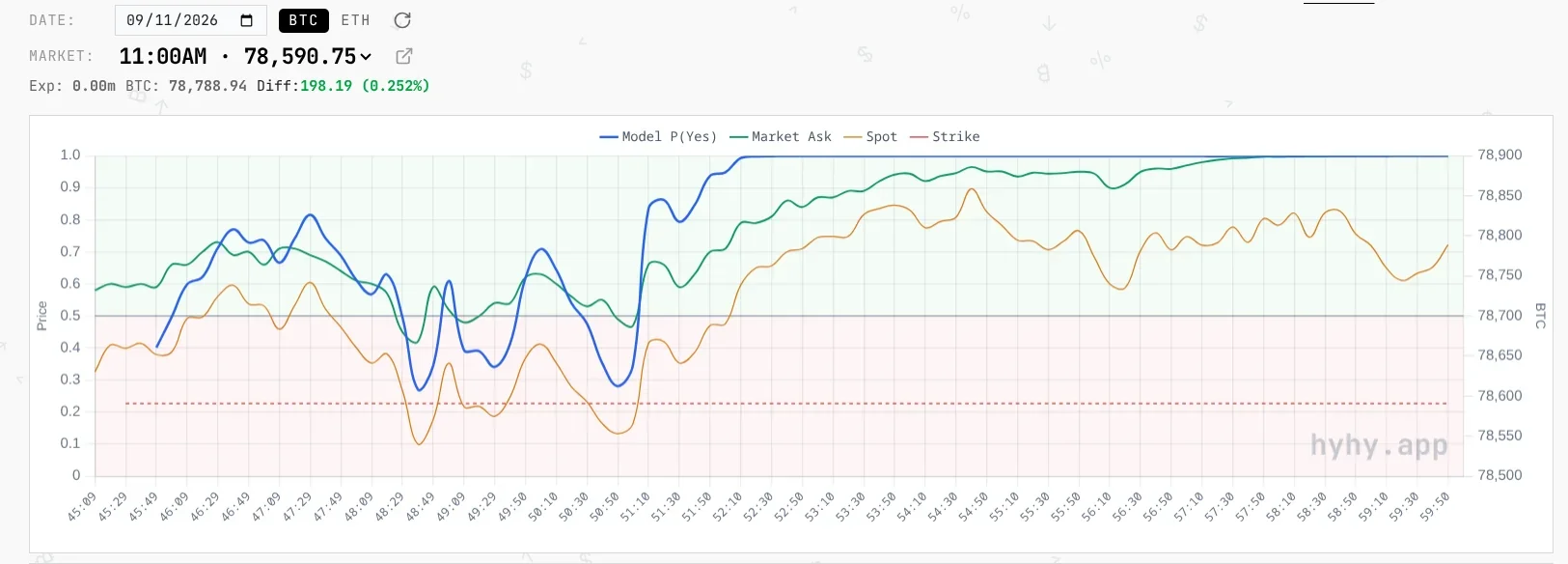
The model leads, the market follows. The gap is wide and lasts long enough that milliseconds of feed skew don't matter.
Importantly, entries need a sustained signal and pass the gates check, so a single odd tick can't trigger a trade on its own.
What is the rule?
If the three feeds are within roughly 10 to 50ms of each other, treat them as one snapshot and price it. That's about as tight as the plumbing allows, and it's tight enough for the job.
Where do I still draw the line?
Every input carries a timestamp. If any feed goes stale beyond the threshold, the pricer doesn't price. A skipped price costs nothing. Whereas a trade entered due to mispricing, where I can't trust the edge, can cost a lot.
The tolerance is deliberate and bounded. It isn't sloppiness.
What is the trap on the other side?
You can also be too careful. If you demand perfectly aligned data before every decision, you build something technically beautiful that never takes a position. The academic ideal is nice to admire, but a model that waits for it never trades, and a model that never trades has no edge to speak of.
Match the precision of your data to the thickness of your edge. If the edge is 10 cents, a cent or two of timing noise is a rounding error.